


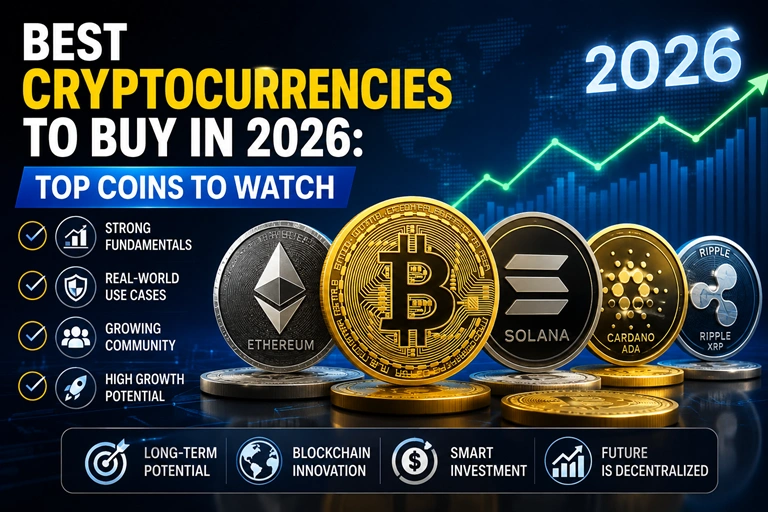
A crypto portfolio can look very different depending on whether you are chasing the next big rally or looking for projects that could remain relevant for years. In 2026, that distinction matters more than ever. Institutional access is expanding, blockchain infrastructure is improving, and networks are competing on everything from transaction costs to real-world asset settlement. So, what are the best cryptocurrencies to buy in 2026? There is no guaranteed winner, but a handful of established projects stand out for very different reasons.
Quick Summary
- Bitcoin (BTC): Strongest candidate for a core crypto allocation and institutional exposure.
- Ethereum (ETH): Leading smart-contract platform with an active scaling roadmap.
- Solana (SOL): High-performance blockchain with growing consumer and institutional use cases.
- Chainlink (LINK): Infrastructure play focused on blockchain data and cross-chain interoperability.
- XRP: A cryptocurrency worth watching for payments and institutional settlement developments.
- Crypto remains highly volatile; a strong project does not automatically mean a good entry price.
What Makes a Cryptocurrency Worth Watching in 2026?
The biggest mistake investors make is judging a cryptocurrency solely by its price chart. A coin trading at $1 may not be “cheaper” than Bitcoin at tens of thousands of dollars. Supply, market capitalization, token economics, adoption and network utility all matter.
For a 2026 watchlist, several factors deserve particular attention.
Network adoption is one of them. Are developers building applications on the blockchain? Are users actually transacting? Is there meaningful economic activity beyond speculation?
Technology also matters. A blockchain that becomes faster, cheaper or easier to use can potentially attract developers and users. Ethereum’s recent upgrades, for example, have focused heavily on scaling and user experience. Its Fusaka upgrade went live in December 2025, while further improvements remain on the 2026 roadmap.
Then there is institutional accessibility. Bitcoin’s integration with traditional financial products has made exposure considerably easier for investors who do not want to manage private keys directly. BlackRock’s iShares Bitcoin Trust, for example, reported tens of billions of dollars in net assets during July 2026.
A sensible watchlist therefore looks beyond hype. It asks a much harder question: What problem does this network solve, and is anyone actually paying to use it?
Best Cryptocurrencies to Buy in 2026
1. Bitcoin (BTC)
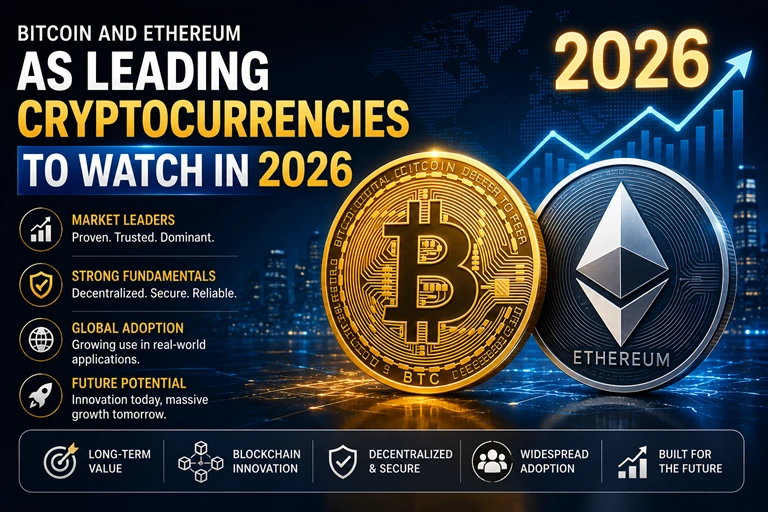
If cryptocurrency were a stock market, Bitcoin would still be the closest thing to the benchmark asset.
Bitcoin’s biggest advantage is not flashy technology. It is its network effect, liquidity, recognition and relatively simple monetary design. The approval and growth of spot Bitcoin exchange-traded products have also helped connect BTC with traditional investment infrastructure.
BlackRock’s IBIT illustrates the scale of that transition. Its reported net assets were approximately $48.8 billion as of July 22, 2026, although the fund’s value naturally changes with the Bitcoin market.
For someone researching the best cryptocurrencies to buy in 2026, Bitcoin is therefore difficult to ignore.
Why watch BTC:
- Strongest institutional recognition among major cryptocurrencies
- Large and liquid global market
- Fixed maximum supply of 21 million BTC
- Increasing integration with traditional financial markets
- Often treated as the benchmark for the wider crypto market
The catch? Bitcoin is still volatile. Institutional adoption does not eliminate drawdowns, and buying after a major rally can produce poor short-term results even when the long-term thesis remains intact.
2. Ethereum (ETH)
Ethereum occupies a completely different position from Bitcoin. Rather than primarily functioning as a digital monetary asset, Ethereum provides infrastructure for smart contracts, decentralized applications, stablecoins, tokenized assets and Layer-2 networks.
That makes ETH particularly interesting for investors who believe blockchain-based financial infrastructure will continue expanding.
Ethereum’s development has also been unusually active. Pectra went live in May 2025, introducing improvements including EIP-7702 and increased validator flexibility. Fusaka followed in December 2025 with PeerDAS and additional data-availability improvements. Ethereum’s roadmap lists further work for 2026, including Glamsterdam and Hegotá development.
There is an important nuance here. Ethereum’s success as a network does not automatically guarantee ETH price appreciation. Investors need to consider how network activity translates into demand for the token, as well as competition from alternative blockchains.
Still, ETH remains one of the most important crypto assets to watch.
Why watch ETH:
- Major smart-contract ecosystem
- Extensive developer infrastructure
- Strong presence in DeFi and stablecoins
- Active scaling and usability roadmap
- Significant institutional interest
3. Solana (SOL)
Solana is the higher-growth, higher-risk candidate on this list.
Its appeal comes from performance. The network has positioned itself around fast transactions, low costs and applications that need high throughput. That has helped it attract activity across DeFi, consumer applications, payments and digital assets.
The network is also continuing to evolve technically. Solana’s July 2026 upgrade information shows a mainnet block-capacity increase from 60 million to 100 million compute units, while other planned changes include larger transactions and the Alpenglow consensus upgrade targeting substantially faster finality.
Developer infrastructure continues to receive attention too, with Agave and Firedancer releases shipping throughout July.
That creates an interesting investment thesis: if blockchain applications increasingly need speed and throughput, Solana could benefit from that demand.
But SOL comes with more uncertainty than BTC. Network competition, technical risks, token economics and changing user activity can all affect its long-term performance.
Why watch SOL:
- High-throughput blockchain architecture
- Strong developer and application ecosystem
- Continued validator and protocol improvements
- Potential exposure to consumer-facing blockchain applications
- Increasing institutional and enterprise experimentation
4. Chainlink (LINK)
Chainlink is an interesting choice because it is not trying to become another general-purpose blockchain in exactly the same way as Ethereum or Solana.
Instead, Chainlink focuses heavily on infrastructure: connecting smart contracts with external data and enabling interoperability between blockchain networks.
That becomes increasingly relevant if tokenized real-world assets, stablecoins and cross-chain applications continue expanding.
Chainlink’s CCIP infrastructure continued adding integrations during 2026. Its official release notes show new cross-chain token support and an expansion of CCIP to networks including Canton and Robinhood Chain.
This makes LINK an infrastructure-focused cryptocurrency to watch rather than a straightforward “Bitcoin alternative.”
Why watch LINK:
- Oracle infrastructure for blockchain applications
- Cross-chain interoperability through CCIP
- Exposure to tokenization trends
- Increasing integrations across blockchain networks
- Potential benefit from institutional blockchain infrastructure
The primary risk is valuation. A useful technology can exist without its token becoming a spectacular investment. Investors should examine LINK’s token economics and actual value capture rather than assuming ecosystem growth automatically translates into price growth.
5. XRP
XRP deserves a place on the watchlist for investors interested in cryptocurrency’s payments and institutional-settlement narrative.
Its investment case is different from Bitcoin, Ethereum and Solana. Rather than focusing primarily on decentralized applications, XRP’s long-running thesis has centered around fast transfers and financial infrastructure.
That distinction matters. A cryptocurrency can have substantial name recognition while still facing questions around adoption, competition, regulatory developments and token economics.
For that reason, XRP may be better viewed as a higher-risk satellite position or watchlist asset rather than automatically treating it as a core holding.
When researching XRP in 2026, pay particular attention to actual payment-network usage, institutional integrations, regulatory developments and whether adoption is producing sustainable demand.
How Should You Compare Crypto Coins in 2026?
A good crypto comparison goes deeper than “Which coin will go up the most?”
Adoption and real usage
Look at active users, transaction activity, developer participation, stablecoin activity and applications generating economic activity. Metrics can be noisy, but they are more informative than social-media excitement.
Token economics
Study supply schedules, staking emissions, token unlocks, burns and concentration of ownership. Two projects with similar market capitalizations can have very different supply dynamics.
Technology and development
Check whether a project is actually shipping improvements. Ethereum’s 2026 protocol work and Solana’s ongoing validator and performance upgrades are examples of why development activity can be worth monitoring.
Competition
Every major blockchain faces competition. Ethereum competes with high-performance Layer-1 networks and other smart-contract ecosystems. Solana competes for developers and users. Oracle and interoperability projects face competing infrastructure providers.
A strong investment thesis should explain why the project can win despite those competitors.
Regulatory and custody risks
Crypto is still affected by changing regulations, exchange policies, taxation rules and custody requirements. These risks can matter just as much as technical fundamentals.
Should You Buy Bitcoin, Ethereum or Altcoins First?
For someone building a crypto watchlist from scratch, the answer depends on risk tolerance.
Bitcoin is generally the simplest place to begin researching because its investment thesis is easier to understand and it has the deepest institutional market.
Ethereum adds exposure to the broader blockchain application economy.
Solana offers potentially greater growth exposure but also greater project and market risk.
Chainlink gives investors exposure to blockchain infrastructure rather than another competing Layer-1.
XRP provides a different payments-focused thesis.
That is why simply asking for the “best crypto” can be misleading. The more useful question is: Which crypto thesis do you understand well enough to hold through a 50% drawdown?
Crypto markets can move violently. A technically strong project can fall sharply during a broader risk-off period. Your ability to manage volatility may therefore matter more than finding a perfect coin.
Crypto Investment Strategy: What Should Investors Watch Next?
Rather than trying to predict the exact top and bottom of the market, investors can create a checklist and revisit it regularly.
Track network activity, developer releases, major protocol upgrades, institutional products, regulatory developments and token supply changes. Also watch whether a project’s users are growing for genuine reasons or because of temporary incentives.
Ethereum is a good example of why this approach works. Its recent upgrades have produced measurable changes in scalability and validator functionality, while its roadmap continues to evolve.
Solana provides another example. Its 2026 roadmap includes major capacity and performance changes, giving investors concrete technical milestones to follow rather than relying only on price predictions.
And Bitcoin’s institutional products offer a useful indicator of how traditional finance is interacting with crypto. IBIT alone reported billions of dollars in assets during July 2026.
The practical lesson is simple: follow adoption and execution, not just price targets.
Risks to Consider Before Buying Cryptocurrency
Cryptocurrency should never be treated as a guaranteed wealth-building strategy.
Prices can decline dramatically, sometimes without an obvious warning. Smaller altcoins can experience even larger losses because they generally have lower liquidity and greater dependence on market sentiment.
There are also risks beyond price:
- Smart-contract vulnerabilities can lead to permanent losses.
- Exchanges and custodians can experience operational or security problems.
- Regulatory changes can affect availability or demand.
- Token unlocks can create additional selling pressure.
- Network competition can weaken a project’s long-term position.
- High leverage can turn ordinary volatility into catastrophic losses.
A useful rule is to avoid investing money that you cannot afford to leave untouched for a long period. Never build a portfolio around a promised return or a social-media price prediction.
This article is educational rather than personalized financial advice. Before buying any cryptocurrency, review the project’s documentation, token economics, risks and your own financial circumstances.
Frequently Asked Questions
What are the best cryptocurrencies to buy in 2026?
Bitcoin, Ethereum, Solana, Chainlink and XRP are among the major cryptocurrencies worth researching in 2026. Each has a different investment thesis, so investors should compare adoption, technology, token economics, competition and risk rather than relying on price predictions.
Is Bitcoin still worth buying in 2026?
Bitcoin remains one of the most established cryptocurrencies and has significant institutional exposure through exchange-traded products. However, it remains volatile, so whether it is suitable depends on an investor’s objectives, risk tolerance and investment horizon.
Which crypto has the most growth potential in 2026?
Solana is one of the higher-growth cryptocurrencies to watch because of its focus on throughput, consumer applications and continued network upgrades. Higher potential growth also comes with higher technological, competitive and market risks.
Should I buy crypto for the long term?
Long-term crypto investing can make sense only for investors who understand the risks and can tolerate substantial volatility. Research the underlying network, token economics, adoption and competitive position instead of buying solely because an asset has recently risen.
Conclusion
The best cryptocurrencies to buy in 2026 are not necessarily the coins promising the most dramatic returns. The stronger approach is to identify networks with credible technology, meaningful adoption, active development and a clear reason for their tokens to remain relevant.
Bitcoin remains the benchmark. Ethereum provides broad smart-contract exposure. Solana offers a higher-risk performance thesis, while Chainlink provides infrastructure exposure and XRP represents a payments-focused opportunity.
There is no guaranteed winner. The smartest crypto watchlist is one built around strong fundamentals, realistic expectations and disciplined risk management—not the loudest prediction on social media.