

Introduction
The zodiac signs in sequence follow a fixed order that makes the entire Western zodiac easier to understand. Starting with Aries and ending with Pisces, the 12 signs form a continuous cycle rather than a simple beginning-to-end list. Each sign occupies a particular position on the traditional zodiac wheel and has its own symbol, element, and modality.
Knowing this sequence can help you quickly identify which sign comes before or after another, understand the relationship between neighboring signs, and recognize repeating patterns among the elements and modalities. In this guide, we’ll walk through Aries to Pisces in order, explain what each position traditionally represents, and show how the signs fit together as one complete zodiac cycle.
Note: This article uses the Western tropical zodiac. Traditional astrological personality descriptions are presented as astrology-based interpretations and are not scientifically proven personality assessments.
The 12 Zodiac Signs in Sequence
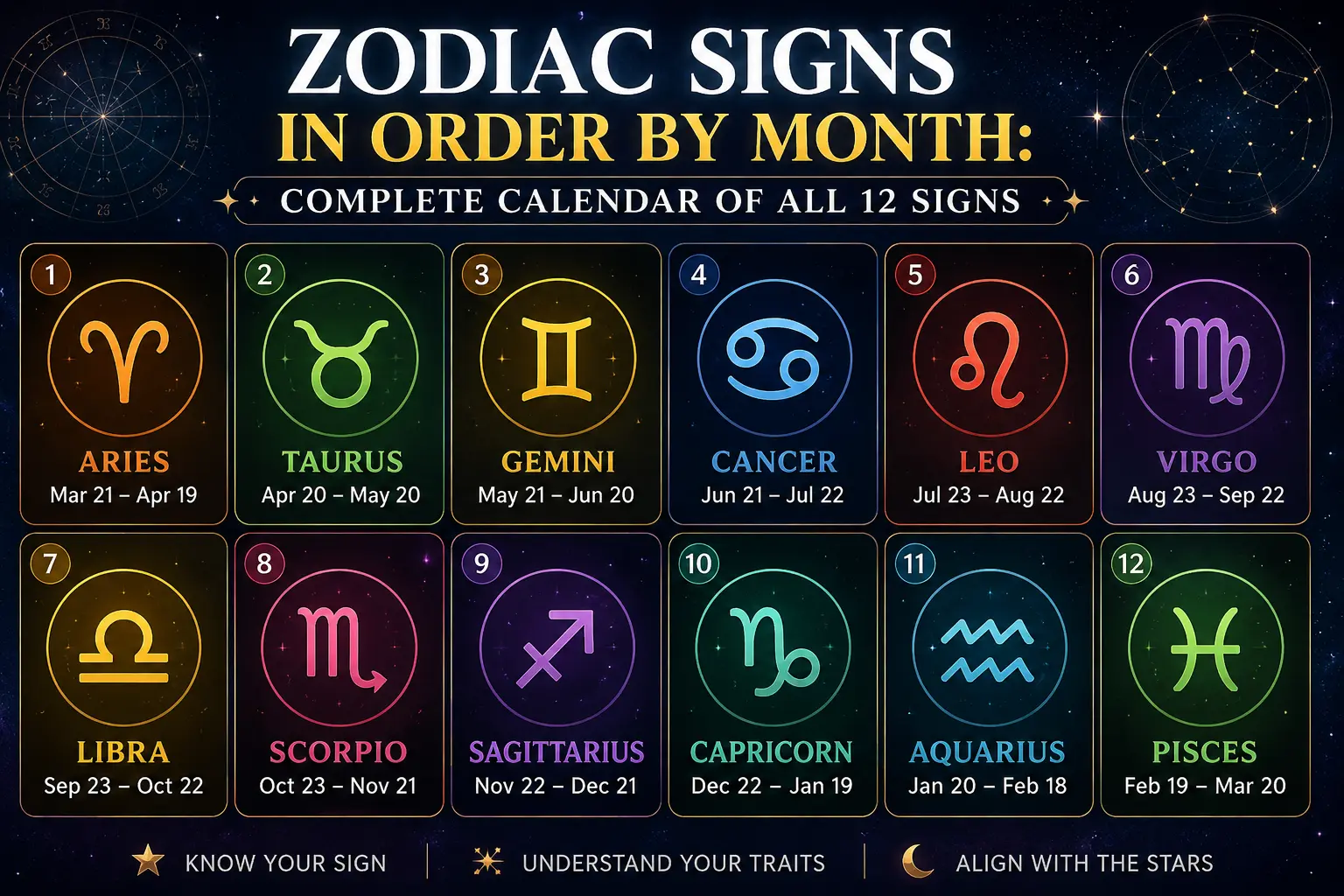
The traditional Western zodiac follows this order:
Aries → Taurus → Gemini → Cancer → Leo → Virgo → Libra → Scorpio → Sagittarius → Capricorn → Aquarius → Pisces
After Pisces, the sequence returns to Aries, creating a repeating wheel.
| # | Zodiac Sign | Common Date Range | Symbol | Element | Modality |
| 1 | Aries | March 21 – April 19 | Ram ♈ | Fire | Cardinal |
| 2 | Taurus | April 20 – May 20 | Bull ♉ | Earth | Fixed |
| 3 | Gemini | May 21 – June 20 | Twins ♊ | Air | Mutable |
| 4 | Cancer | June 21 – July 22 | Crab ♋ | Water | Cardinal |
| 5 | Leo | July 23 – August 22 | Lion ♌ | Fire | Fixed |
| 6 | Virgo | August 23 – September 22 | Maiden ♍ | Earth | Mutable |
| 7 | Libra | September 23 – October 22 | Scales ♎ | Air | Cardinal |
| 8 | Scorpio | October 23 – November 21 | Scorpion ♏ | Water | Fixed |
| 9 | Sagittarius | November 22 – December 21 | Archer ♐ | Fire | Mutable |
| 10 | Capricorn | December 22 – January 19 | Sea-Goat ♑ | Earth | Cardinal |
| 11 | Aquarius | January 20 – February 18 | Water-Bearer ♒ | Air | Fixed |
| 12 | Pisces | February 19 – March 20 | Fish ♓ | Water | Mutable |
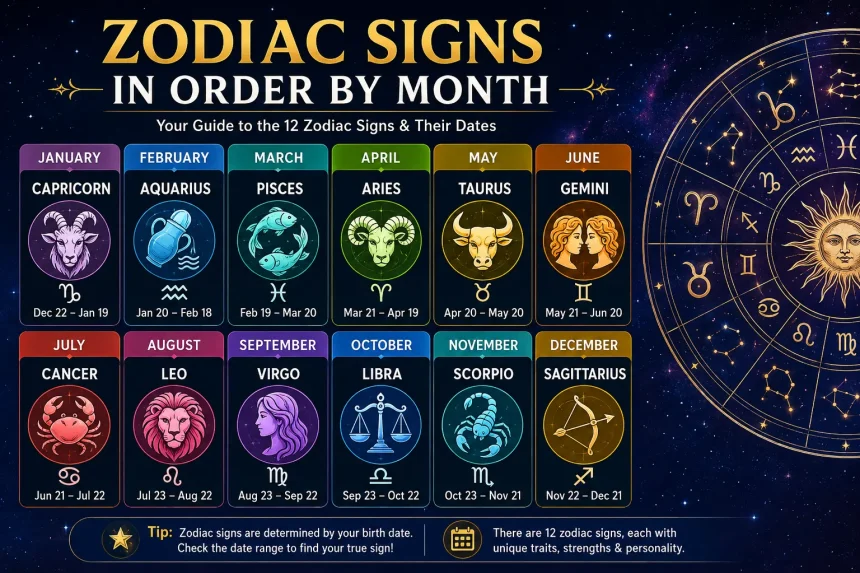
These are commonly used date ranges rather than exact astronomical transition times. The Sun can change signs at different times from year to year, and the local date can also differ depending on the time zone.
How the Zodiac Wheel Works
The zodiac wheel is traditionally divided into 12 signs, each occupying an equal 30-degree section of the 360-degree zodiac.
The sequence starts with Aries in the Western tropical zodiac and proceeds through the other 11 signs until Pisces.
The basic structure is:
- Aries
2. Taurus
3. Gemini
4. Cancer
5. Leo
6. Virgo
7. Libra
8. Scorpio
9. Sagittarius
10. Capricorn
11. Aquarius
12. Pisces
Then the cycle begins again:
Pisces → Aries
This circular structure is why the zodiac is commonly represented as a wheel rather than a straight line.
1. Aries: The Beginning of the Sequence
Position: 1st
Symbol: Ram ♈
Element: Fire
Modality: Cardinal
Aries occupies the first position in the traditional Western zodiac.
Traditional astrology associates Aries with initiative, action, independence, confidence, and enthusiasm. Its Cardinal modality is associated with beginnings and taking initiative.
Aries in the zodiac sequence
Aries represents the starting point of the traditional cycle.
Aries → Taurus
The next sign introduces a shift from Fire to Earth and from Cardinal to Fixed.
2. Taurus: Building Stability
Position: 2nd
Symbol: Bull ♉
Element: Earth
Modality: Fixed
Taurus follows Aries.
Traditional astrology connects Taurus with stability, patience, persistence, practicality, and dependability.
Its Fixed modality is traditionally associated with maintaining and developing what has already been started.
Taurus in the zodiac sequence
Aries → Taurus → Gemini
The transition from Aries to Taurus can be viewed symbolically as moving from initiation toward stability.
3. Gemini: Exploring Ideas
Position: 3rd
Symbol: Twins ♊
Element: Air
Modality: Mutable
Gemini is the third sign.
Its traditional associations include communication, curiosity, learning, adaptability, and variety.
As a Mutable sign, Gemini is traditionally connected with flexibility and adjustment.
Gemini in the zodiac sequence
Taurus → Gemini → Cancer
The element changes from Earth to Air, creating a symbolic movement from practical stability toward communication and ideas.
4. Cancer: Emotional Connection
Position: 4th
Symbol: Crab ♋
Element: Water
Modality: Cardinal
Cancer follows Gemini.
Traditional astrology associates Cancer with home, family, nurturing, emotional connection, protection, and sensitivity.
As a Cardinal sign, Cancer is traditionally associated with initiating or establishing something—in this case, within a more emotional and personal context.
Cancer in the zodiac sequence
Gemini → Cancer → Leo
The transition introduces Water after Air and begins the next four-sign elemental cycle.
5. Leo: Creativity and Expression
Position: 5th
Symbol: Lion ♌
Element: Fire
Modality: Fixed
Leo occupies the fifth position.
Traditional astrology connects Leo with creativity, confidence, warmth, self-expression, generosity, and leadership.
Its Fixed modality is associated with consistency and sustained expression.
Leo in the zodiac sequence
Cancer → Leo → Virgo
The sequence returns to Fire with Leo, beginning another elemental pattern.
6. Virgo: Practical Refinement
Position: 6th
Symbol: Maiden ♍
Element: Earth
Modality: Mutable
Virgo follows Leo.
Traditional Virgo themes include analysis, organization, practicality, precision, and attention to detail.
Its Mutable quality is traditionally associated with adapting and refining.
Virgo in the zodiac sequence
Leo → Virgo → Libra
Virgo changes the element from Fire to Earth and shifts the modality from Fixed to Mutable.
7. Libra: Balance and Relationships
Position: 7th
Symbol: Scales ♎
Element: Air
Modality: Cardinal
Libra is the seventh sign.
It is traditionally associated with balance, diplomacy, cooperation, relationships, harmony, and fairness.
Libra is particularly recognizable because its symbol is the Scales, unlike the animal or human figures associated with many other zodiac signs.
Libra in the zodiac sequence
Virgo → Libra → Scorpio
Libra begins the third four-sign elemental pattern.
8. Scorpio: Depth and Determination
Position: 8th
Symbol: Scorpion ♏
Element: Water
Modality: Fixed
Scorpio follows Libra.
Traditional astrology associates Scorpio with intensity, determination, focus, emotional depth, loyalty, and transformation.
Its Fixed modality is traditionally associated with persistence and staying power.
Scorpio in the zodiac sequence
Libra → Scorpio → Sagittarius
Scorpio completes the second Water position in the sequence before Sagittarius brings the pattern back to Fire.
9. Sagittarius: Exploration and Discovery
Position: 9th
Symbol: Archer ♐
Element: Fire
Modality: Mutable
Sagittarius is the ninth zodiac sign.
Its Archer symbol is traditionally associated with exploration, adventure, learning, discovery, optimism, and broader horizons.
As a Mutable Fire sign, Sagittarius combines traditional Fire themes with adaptability and movement.
Sagittarius in the zodiac sequence
Scorpio → Sagittarius → Capricorn
The cycle returns to Fire as it enters the final four-sign group.
10. Capricorn: Structure and Responsibility
Position: 10th
Symbol: Sea-Goat ♑
Element: Earth
Modality: Cardinal
Capricorn follows Sagittarius.
Traditional astrology associates Capricorn with discipline, responsibility, persistence, structure, ambition, and long-term goals.
Its Cardinal modality is associated with initiating action, while Earth is traditionally connected with practical and grounded concerns.
Capricorn in the zodiac sequence
Sagittarius → Capricorn → Aquarius
Capricorn is the first Earth sign in the final four-sign group.
11. Aquarius: Independent Ideas
Position: 11th
Symbol: Water-Bearer ♒
Element: Air
Modality: Fixed
Aquarius is the eleventh sign.
Although its symbol is the Water-Bearer, Aquarius is traditionally classified as an Air sign, not a Water sign.
Traditional Aquarius themes include independence, originality, innovation, individuality, and unconventional thinking.
Aquarius in the zodiac sequence
Capricorn → Aquarius → Pisces
Aquarius brings the final Air sign into the sequence.
12. Pisces: Completing the Cycle
Position: 12th
Symbol: Fish ♓
Element: Water
Modality: Mutable
Pisces is the 12th and final sign in the traditional zodiac sequence.
Traditional astrology associates Pisces with imagination, compassion, sensitivity, intuition, creativity, and emotional depth.
But Pisces isn’t an endpoint in the sense of stopping the zodiac.
Pisces in the zodiac sequence
Aquarius → Pisces → Aries
After Pisces, the zodiac wheel returns to Aries.
This makes the complete structure circular rather than linear.
The Element Pattern in the Zodiac Sequence
One of the easiest ways to remember the zodiac order is to look at the elements.
The four elements are:
- Fire
- Earth
- Air
- Water
The sequence follows a repeating pattern:
Aries — Fire
Taurus — Earth
Gemini — Air
Cancer — Water
Then it repeats:
Leo — Fire
Virgo — Earth
Libra — Air
Scorpio — Water
And once more:
Sagittarius — Fire
Capricorn — Earth
Aquarius — Air
Pisces — Water
So the elemental sequence can be remembered as:
Fire → Earth → Air → Water
repeated three times.
Zodiac Signs by Modality
The zodiac also follows a repeating pattern of three modalities.
Cardinal Signs
Aries, Cancer, Libra, Capricorn
Cardinal signs are traditionally associated with beginnings, initiative, and action.
Fixed Signs
Taurus, Leo, Scorpio, Aquarius
Fixed signs are traditionally associated with stability, persistence, and maintaining momentum.
Mutable Signs
Gemini, Virgo, Sagittarius, Pisces
Mutable signs are traditionally associated with adaptability, flexibility, and transition.
The modality sequence looks like:
Cardinal → Fixed → Mutable
This pattern repeats four times across the 12 signs.
How Elements and Modalities Work Together
Each zodiac sign has both an element and a modality.
For example:
| Zodiac Sign | Element | Modality |
| Aries | Fire | Cardinal |
| Taurus | Earth | Fixed |
| Gemini | Air | Mutable |
| Cancer | Water | Cardinal |
| Leo | Fire | Fixed |
| Virgo | Earth | Mutable |
| Libra | Air | Cardinal |
| Scorpio | Water | Fixed |
| Sagittarius | Fire | Mutable |
| Capricorn | Earth | Cardinal |
| Aquarius | Air | Fixed |
| Pisces | Water | Mutable |
This creates a distinctive combination for every sign.
For instance, Aries and Capricorn are both Cardinal signs, but Aries is Fire while Capricorn is Earth. Similarly, Taurus and Aquarius are both Fixed signs, but they belong to different elements.
Zodiac Signs in Sequence by Season
The zodiac sequence is also connected with the seasons in the Northern Hemisphere through the tropical zodiac.
Spring
- Aries
- Taurus
- Gemini
Summer
- Cancer
- Leo
- Virgo
Autumn/Fall
- Libra
- Scorpio
- Sagittarius
Winter
- Capricorn
- Aquarius
- Pisces
This seasonal grouping is based on the tropical zodiac’s relationship with the Northern Hemisphere’s seasonal cycle.
For readers in India, the traditional four-season framework may not correspond neatly to local weather patterns everywhere. The zodiac grouping here refers to the Western tropical astrological framework rather than India’s regional climate seasons.
Why Aries Comes First
In Western tropical astrology, Aries is traditionally placed at the beginning of the zodiac.
The tropical zodiac begins at the vernal equinox, which marks the starting point of the Aries sector in this system.
This means Aries is not simply first because of an arbitrary alphabetical or calendar arrangement. Its position is connected to the structure of the tropical zodiac itself.
Why Pisces Comes Before Aries
If Pisces is the 12th sign, why does Aries come after it?
Because the zodiac is a circle.
Imagine a clock. After 12 o’clock, the clock doesn’t stop; it returns to 1 o’clock. The zodiac follows a similar circular concept:
… Aquarius → Pisces → Aries → Taurus …
This is why asking what comes after Pisces has a clear answer: Aries.
Zodiac Sequence vs. Zodiac Dates
The order of the signs never changes, but their exact transition dates can vary slightly depending on the year and location.
For general reference, the commonly used ranges are:
- Aries: March 21–April 19
- Taurus: April 20–May 20
- Gemini: May 21–June 20
- Cancer: June 21–July 22
- Leo: July 23–August 22
- Virgo: August 23–September 22
- Libra: September 23–October 22
- Scorpio: October 23–November 21
- Sagittarius: November 22–December 21
- Capricorn: December 22–January 19
- Aquarius: January 20–February 18
- Pisces: February 19–March 20
These should be treated as general calendar guides. If you were born on a boundary date, your exact birth time and location can be important.
What Is a Zodiac Cusp?
A zodiac cusp generally refers to a birth date close to the transition between two zodiac signs.
For example, someone born near the transition from:
Pisces → Aries
might see different results on generic zodiac websites.
The most accurate approach within Western astrology is to calculate the Sun’s position using the person’s exact:
- Birth date
- Birth time
- Birthplace
It is better to determine the actual Sun sign than to assume that someone automatically has two Sun signs simply because their birthday falls near a commonly published boundary.
Western Zodiac and Vedic Astrology
The zodiac sequence described here belongs to the Western tropical zodiac.
Readers in India may also encounter Vedic astrology, which generally uses a sidereal zodiac. Because the tropical and sidereal systems use different reference frameworks, the sign associated with the same birthday may sometimes differ.
This distinction is important when reading online horoscopes. Before comparing two zodiac results, check whether both sources are using the same astrological system.
Does Zodiac Order Determine Personality?
The sequence of the zodiac is a traditional astrological framework. The personality characteristics associated with individual signs are also based on astrological tradition.
For example:
- Aries is traditionally associated with initiative.
- Taurus with stability.
- Gemini with communication.
- Cancer with nurturing.
- Leo with self-expression.
- Virgo with analysis.
- Libra with balance.
- Scorpio with intensity.
- Sagittarius with exploration.
- Capricorn with discipline.
- Aquarius with originality.
- Pisces with imagination.
These descriptions can be useful when studying astrology, but they should not be presented as scientifically proven ways to determine someone’s personality.
A person’s actual personality is shaped by many factors, including biology, environment, experiences, relationships, and culture.
A Simple Way to Memorize the Zodiac Sequence
If you’re struggling to remember all 12 signs, break them into four groups of three:
Group 1
Aries → Taurus → Gemini
Group 2
Cancer → Leo → Virgo
Group 3
Libra → Scorpio → Sagittarius
Group 4
Capricorn → Aquarius → Pisces
Then connect the groups:
Aries → Taurus → Gemini → Cancer → Leo → Virgo → Libra → Scorpio → Sagittarius → Capricorn → Aquarius → Pisces
Finally, remember:
Pisces → Aries
That completes the wheel.
Frequently Asked Questions
What is the correct sequence of the 12 zodiac signs?
The 12 zodiac signs in sequence are Aries, Taurus, Gemini, Cancer, Leo, Virgo, Libra, Scorpio, Sagittarius, Capricorn, Aquarius, and Pisces. After Pisces, the cycle returns to Aries.
Why does Aries come first in the zodiac?
Aries comes first in the Western tropical zodiac because the tropical zodiac begins at the point associated with the vernal equinox. This establishes Aries as the first 30-degree sign of the traditional tropical zodiac.
What zodiac sign comes after Pisces?
Aries comes after Pisces. Pisces is the 12th sign, and the zodiac is traditionally represented as a continuous circle, so the sequence begins again with Aries.
What are the four zodiac elements in order?
The traditional zodiac elements are Fire, Earth, Air, and Water. This pattern repeats three times: Aries–Cancer, Leo–Scorpio, and Sagittarius–Pisces each contain one Fire, Earth, Air, and Water sign in that order.
Are zodiac signs arranged according to the calendar months?
The zodiac signs are associated with calendar date ranges, but they are not assigned one complete month each. Most months contain portions of two zodiac signs, while the signs themselves remain in a fixed sequence.
Can zodiac sign dates vary?
Yes, the exact transition between zodiac signs can vary by year and time zone. Common zodiac calendars provide general date ranges, but people born near a boundary may need their exact birth time and birthplace to determine their Sun sign more precisely.
Conclusion
Understanding the zodiac signs in sequence gives you a foundation for exploring Western astrology. The 12 signs move in a consistent order:
Aries → Taurus → Gemini → Cancer → Leo → Virgo → Libra → Scorpio → Sagittarius → Capricorn → Aquarius → Pisces
Each sign combines a traditional element, modality, symbol, and set of astrological themes. The elements follow a repeating Fire–Earth–Air–Water pattern, while the modalities repeat Cardinal–Fixed–Mutable.
Most importantly, the zodiac is a cycle. Pisces does not permanently end the sequence; it leads directly back to Aries, creating the continuous zodiac wheel.
Once you know this structure, it becomes much easier to understand zodiac dates, symbols, elements, compatibility discussions, and birth-chart terminology. If you’re continuing your astrology research, exploring zodiac signs by month, zodiac elements, zodiac compatibility, and Moon signs is a natural next step.