


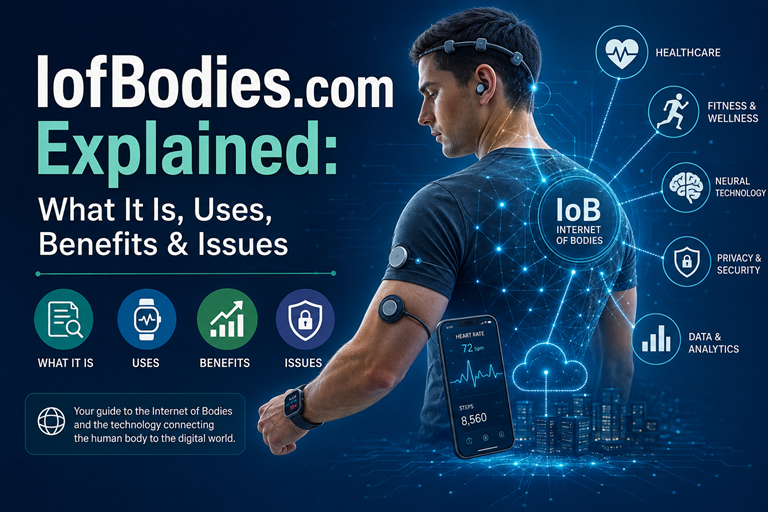
IofBodies.com Is Getting Attention. But What Is It Actually About?
A smartwatch can count your steps. A glucose sensor can monitor blood sugar. A medical implant can send information to another device. Put those ideas together and you begin to see why the Internet of Bodies has become such an interesting technology topic.
That is where iofbodies.com enters the conversation.
The website currently presents itself as an informational resource focused on the Internet of Bodies, including connected sensors, healthcare technology, wellness, neural engineering, human augmentation, privacy, and ethics. But there is a catch: descriptions of the domain across the wider web have not always been consistent. That makes it worth looking beyond the name and examining what the site actually offers, what IoB technology means, and what readers should be careful about.
Quick Takeaways
- IofBodies.com currently focuses on information about Internet of Bodies technology.
- Its subject areas include healthcare, wellness, sensors, neural engineering, human augmentation, privacy, and ethics.
- IoB technology connects the human body with sensors, software, networks, and digital systems.
- The technology has legitimate applications in healthcare, fitness, research, and assistive technology.
- Body-generated data creates serious privacy, security, consent, and ownership questions.
- IofBodies.com should be treated as an educational starting point, not automatically as a medical provider or technology manufacturer.
- Claims about specific products or services associated with the domain should be independently verified.
What Is IofBodies.com?
At first glance, the name “IofBodies” can be confusing. It is closely associated with the phrase Internet of Bodies, or IoB, which describes connected technologies capable of collecting, transmitting, processing, or interacting with information related to the human body.
IofBodies.com currently describes itself around that broader concept. Its listed topics span healthcare and wellness as well as bioelectronic sensors, data processing, communication protocols, neural engineering, human augmentation, ethics, and privacy.
That distinction is important.
The Internet of Bodies is a technology concept. IofBodies.com is a website discussing that concept. Those are not necessarily the same thing.
Someone searching for the domain might assume it is a health app, wearable-device company, medical service, or IoT platform. The current presentation of the site does not establish that it operates as all of those things. Readers should therefore separate information about IoB technology from claims about what IofBodies.com itself provides.
That simple distinction can prevent a lot of confusion.
Why Is the Internet of Bodies Important?
The Internet of Bodies represents a progression from ordinary connected devices toward technology that interacts directly with biological information.
Consider the difference:
A traditional smart-home device might tell you the temperature of a room. A wearable device might tell you your heart rate. A medical sensor might continuously collect physiological information.
The closer technology gets to the human body, the more valuable—and potentially sensitive—the information becomes.
That is what makes IoB different from many ordinary Internet of Things applications.
What Does IofBodies.com Cover?
IofBodies.com’s current subject areas make sense when viewed through the wider IoB ecosystem.
Healthcare and Medical Applications
Healthcare is one of the most obvious applications of connected body technology.
Modern medical technology can collect physiological measurements and make them available to patients, clinicians, researchers, or automated systems. Depending on the device and regulatory environment, this can support monitoring, diagnosis, treatment, research, or long-term disease management.
Examples across the broader IoB landscape include connected medical devices, wearable monitors, biosensors, and other technologies designed to capture biological signals.
IofBodies.com includes medical diagnosis and treatment among its areas of discussion.
That does not mean information found on the site should be interpreted as medical advice. Health-related claims require a higher standard of verification, particularly when a reader is considering treatment or changing medical behavior.
Wearables, Fitness and Wellness
This is probably the most familiar side of the Internet of Bodies.
Smartwatches and fitness trackers have already made body-related data part of everyday life. Users can monitor activity, heart rate, sleep-related measurements, workouts, and other metrics depending on the device.
The interesting question is what happens next.
As sensors become smaller and more capable, more types of physiological information may become available continuously rather than during occasional medical appointments or laboratory tests.
That could make personal health tracking more useful. It also means users need to understand what happens to the data after it has been collected.
Bioelectronic Sensors
Sensors are the foundation of many IoB applications.
A sensor detects a signal. Software interprets that signal. A connected system can then store, display, analyze, or transmit the resulting information.
IofBodies.com identifies bioelectronic sensors and devices as one of its technology categories.
For readers, the important takeaway is that “IoB” is not one device. It describes a broad family of technologies ranging from consumer wearables to sophisticated medical and research systems.
Neural Engineering
The most futuristic part of the subject is arguably neural engineering.
Brain-computer interfaces and related technologies attempt to establish communication between neural activity and external technology. Research in this field could eventually contribute to assistive systems, rehabilitation, communication tools, and other applications.
But this area also introduces questions that do not arise in quite the same way with a basic fitness tracker.
Who controls neural information? How should consent work? What happens if such systems are hacked or malfunction? Could a device reveal information a person never intended to share?
Those questions make ethics a central part of IoB—not an afterthought.
How Can IofBodies.com Be Useful?
For most readers, the practical value of IofBodies.com is educational.
Use It to Understand IoB Terminology
The Internet of Bodies brings together concepts from several fields:
- Healthcare
- Wearable technology
- Electronics
- Artificial intelligence
- Data science
- Biotechnology
- Cybersecurity
- Neural engineering
That combination can make the subject difficult for beginners.
A focused resource can provide the background needed to understand unfamiliar terms before moving on to academic papers, technical documentation, regulatory information, or manufacturer specifications.
Use It to Explore Real-World Applications
IoB technology has applications across several areas.
Healthcare is one. Fitness is another. Assistive technology, biomedical research, remote monitoring, biometric systems, and neural interfaces are also part of the larger conversation.
The important point is to avoid treating all of these applications as equally mature.
A consumer fitness tracker and an experimental neural interface may both involve body data, but they have completely different levels of technological maturity, regulation, risk, and practical availability.
Use It to Generate Better Questions
Good technology research does not always begin with an answer.
Sometimes the most useful result of reading an introductory article is discovering the questions you should ask next.
For example:
- What information does this device actually collect?
- How accurate are its measurements?
- Is it a consumer product or a medical device?
- Who owns the collected data?
- Can the data be deleted?
- Is information shared with third parties?
- What happens if the company stops operating?
- Has the technology been independently tested?
Those questions are much more valuable than simply asking whether a device is “smart.”
What Are the Benefits of Internet of Bodies Technology?
The potential benefits are substantial, particularly when the technology is developed and used responsibly.
Continuous Monitoring
Traditional health measurements often provide a snapshot. Connected sensors can potentially provide a longer stream of information.
That can reveal trends that might otherwise be difficult to notice.
For example, a single heart-rate measurement tells you something about one moment. Repeated measurements over time can provide a much broader picture.
Faster Access to Information
Connected devices can transmit measurements quickly. In suitable clinical and research settings, that could help professionals respond to changing conditions more efficiently.
The exact benefit depends on the device, its accuracy, the supporting software, and how the information is interpreted.
Personalized Insights
Body-connected systems can potentially produce information tailored to an individual rather than relying entirely on population averages.
Personalization can be useful in fitness and wellness applications, while healthcare applications require substantially stronger validation and oversight.
Assistive Technology
IoB concepts may also support technologies designed to help people interact with computers or other systems.
This is particularly relevant to neural engineering and human-computer interfaces, where researchers are exploring new ways for people to communicate with technology.
What Are the Biggest Concerns With IofBodies.com and IoB?
The biggest concerns fall into two categories: understanding what the website actually offers and understanding the risks associated with the technology it discusses.
Conflicting Descriptions Online
One reason users may become confused when researching IofBodies.com is that third-party pages have described the domain in different ways.
Some online articles have associated it with wellness services, environmental monitoring, fitness tools, AI-driven platforms, and other capabilities. Those descriptions should not automatically be accepted as evidence of features offered by the current site.
When a claim matters, check the source.
Is it on the official website? Is there documentation? Is there a product page? Is there a privacy policy describing the service? Is there independent evidence?
This approach is particularly useful for relatively obscure domains whose online descriptions may change over time.
Privacy and Data Collection
Privacy is perhaps the biggest issue surrounding IoB technology generally.
A person’s body can generate extremely sensitive information. Depending on the technology, this may include biometric identifiers, physiological measurements, location information, activity patterns, or other health-related data.
Before using any connected health or wearable service, readers should understand:
- What information is collected
- Why it is collected
- How long it is stored
- Where it is stored
- Who can access it
- Whether it is shared
- Whether users can delete it
- What happens when an account is closed
A polished interface does not automatically mean strong privacy.
Accuracy Can Be Misunderstood
Another problem is assuming that a measurement is medically meaningful simply because a device can display it.
Consumer technology may be useful for observing trends without being appropriate for diagnosis.
That distinction is especially important when health decisions are involved.
Rapidly Changing Technology
IoB is still an evolving field. New sensors, algorithms, medical devices, interfaces, and privacy practices can change the landscape quickly.
Information that was accurate several years ago may not describe the current state of a product or technology.
That is why publication dates, official documentation, and current regulatory information matter.
Is IofBodies.com Safe and Trustworthy to Use?
There is no need to make an all-or-nothing judgment.
For general educational research, IofBodies.com can be considered a starting point for learning about the Internet of Bodies.
For medical decisions, privacy-sensitive services, purchases, or technical implementation, use additional sources.
The site’s own disclaimer states that its content is intended for general informational and educational purposes and should not be treated as professional medical, legal, or other specialist advice.
That is a reasonable boundary for a technology-information website.
A good research workflow is:
- Start with the IofBodies.com article or topic page.
- Identify specific claims that matter.
- Look for primary or authoritative sources.
- Check publication dates.
- Verify product specifications directly with manufacturers when relevant.
- For medical questions, consult qualified healthcare professionals.
- For privacy questions, read the actual privacy policy rather than relying on promotional descriptions.
This approach is more reliable than deciding whether a site is trustworthy based solely on its domain name or appearance.
The Bigger Story: Why IoB Could Matter More in the Future
The most interesting thing about IofBodies.com may not be the website itself.
It is the subject.
The Internet of Bodies represents a gradual shift in the relationship between people and technology. For decades, computers were objects we sat in front of. Smartphones moved computing into our hands and pockets. Wearables moved it onto our bodies.
The next stage could involve technology that continuously senses, interprets, or responds to biological information.
That future could produce meaningful benefits in healthcare and accessibility. It could also create difficult debates around surveillance, consent, data ownership, cybersecurity, and human autonomy.
And unlike a forgotten social-media password, some forms of biological information cannot simply be changed.
That is why privacy needs to be part of the IoB conversation from the beginning.
Frequently Asked Questions
What is IofBodies.com?
IofBodies.com is currently presented as an informational website focused on the Internet of Bodies. Its topics include connected body technology, healthcare, wellness, sensors, neural engineering, human augmentation, privacy, and ethics.
Is IofBodies.com a medical website?
IofBodies.com should not automatically be treated as a medical provider or source of personalized medical advice. Its own disclaimer describes its content as general informational and educational material.
What are Internet of Bodies applications?
Internet of Bodies applications include wearable health monitoring, connected medical devices, fitness tracking, bioelectronic sensors, assistive technologies, biometric systems, and emerging neural interfaces.
Why is IoB privacy important?
IoB systems can process highly personal information generated by or about the human body. Privacy questions therefore include data ownership, access, security, sharing, retention, consent, and the ability to delete information.
Final Verdict on IofBodies.com
IofBodies.com is best understood through the subject it covers: the Internet of Bodies.
The website offers a useful starting point for readers trying to understand a complicated intersection of healthcare, wearable technology, sensors, data, and human-computer interaction. Its coverage of privacy and ethics is particularly relevant because the more closely technology interacts with our bodies, the more consequential its data practices become.
At the same time, readers should be cautious about third-party descriptions of the domain. If an article claims that IofBodies.com offers a particular product, medical service, AI system, or specialized feature, verify that claim before relying on it.
The broader lesson is simple: body-connected technology deserves curiosity, but it also deserves skepticism.
That balance is likely to become even more important as IoB technology moves from experimental research and specialized medical applications into more everyday products.