

The European console market is entering an interesting phase. PlayStation 5 is well into its lifecycle, Nintendo has moved into the Switch 2 generation, and Xbox is increasingly treating hardware as one part of a broader gaming ecosystem. At the same time, European consumers are spending more time with digital games, subscriptions and connected services. So, is the console market still a volume-growth story—or is the bigger opportunity now in premium hardware, software and recurring revenue?
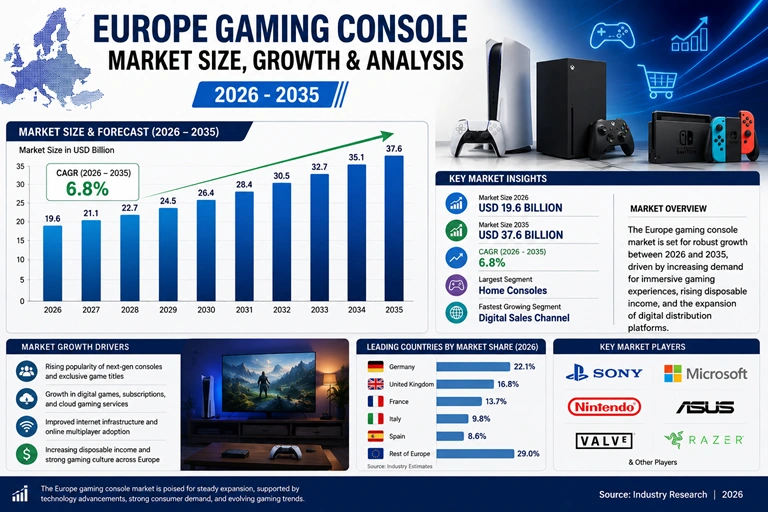
Current estimates vary considerably because research firms use different market definitions. One estimate places the European gaming console market at $4.8 billion in 2025, with a 2.1% CAGR from 2026 to 2035, while another estimates $5.07 billion in 2025 revenue and a 7.8% CAGR through 2033. A separate European console study, using a broader trade and consumption methodology, valued 2023 consumption at $7.8 billion across 18 million units.
That gap is worth understanding rather than ignoring: the underlying direction is clear, but the exact market size depends on whether the analysis covers retail hardware revenue, wholesale value, geography, accessories or other related categories.
Quick Summary
Key Takeaways
- The Europe gaming console market remains a large, mature hardware market, with 2025 estimates ranging from roughly $4.8 billion to $5.1 billion under narrower market definitions.
- Germany, the UK and France are among Europe’s most important gaming markets, while Central and Eastern Europe offer further growth potential.
- PlayStation remains a major force in European console hardware, while Nintendo’s Switch 2 provides a significant new-generation growth catalyst.
- Hardware growth is likely to be more moderate than software, subscriptions and digital services as the market matures.
- Premium consoles, handheld/hybrid devices, cloud-connected gaming and ecosystem services are expected to shape competition through 2035.
- Forecasts differ materially between research providers, so market-size figures should always be compared using the same methodology.
Europe Gaming Console Market Size and Forecast
There is no single universally accepted figure for the Europe gaming console market size. That is not unusual in technology research. One publisher may count consumer hardware revenue, another may measure consumption at wholesale prices, while another may use a broader definition that includes different console categories.
For a narrow market-revenue view, Global Market Insights estimates the European game console market at $4.8 billion in 2025, forecasting a 2.1% CAGR from 2026 to 2035. The report identifies Germany, the UK and France as leading Western European markets and points to Poland and the Czech Republic as important emerging markets in Eastern Europe.
Grand View Research presents a more aggressive outlook. Its estimate puts European gaming-console revenue at $5.071 billion in 2025, rising to a projected $9.336 billion by 2033, equivalent to a 7.8% CAGR from 2026 to 2033. It also identifies PlayStation as the largest product segment in its 2025 assessment.
Another dataset provides a useful volume perspective. IndexBox reports European video-game-console consumption of about 18 million units in 2023, worth approximately $7.8 billion, and forecasts the market to reach around 20 million units and $8.6 billion by 2035, representing roughly 0.9% annual growth.
The practical takeaway is more important than choosing one forecast and treating it as absolute truth: Europe is a mature but resilient console market, and growth is likely to be driven increasingly by replacement cycles, premium products, new form factors and ecosystem spending rather than explosive unit expansion.
Why Do Market Forecasts Differ?
For businesses using these numbers for strategy or investment research, methodology matters.
A market valued at $4.8 billion under one definition should not be directly compared with an $8 billion-plus estimate without checking what each study includes. Differences can arise from:
- Retail versus wholesale valuation
- Hardware-only versus broader console categories
- Europe versus the European Union
- Inclusion or exclusion of handheld and hybrid consoles
- Currency conversion assumptions
- Treatment of accessories and related products
- Different base years and forecast periods
This is particularly relevant when discussing the 2026–2035 outlook. A forecast with a higher CAGR is not necessarily “more accurate”; it may simply be measuring a different addressable market.
What Is Driving the Europe Gaming Console Market?
The European market has several structural advantages. Gaming is no longer a niche hobby dominated by teenagers buying boxed games. It is a mainstream entertainment category spanning families, young adults and older players.
The latest European industry data reinforces that scale. Video Games Europe and the European Games Developer Federation reported €26.8 billion in revenue across key European markets, up 4% from 2023. Their data also indicates that 54% of Europeans aged 6–64 play video games, while 75% of players are adults and the average player age is 31.
That broad audience matters for console manufacturers because it expands the addressable market beyond traditional enthusiast players.
Premium Gaming Experiences
Modern consoles compete on more than raw processing power. Faster storage, 4K output, high frame rates, ray tracing, immersive audio and improved controllers have created a premium segment where consumers may accept higher prices when the overall experience feels meaningfully better.
But there is a limit. Hardware affordability remains a central issue, particularly as component costs and premium specifications push console prices upward. Recent industry commentary around rising hardware costs illustrates the tension: manufacturers and publishers benefit from strong ecosystems, but consumers ultimately decide whether the value proposition justifies the price.
Digital Games and Subscriptions
The console itself is increasingly the entry point to a broader commercial ecosystem.
Digital storefronts, game subscriptions, downloadable content, online multiplayer memberships and virtual items can generate revenue long after the original hardware purchase. This changes the economics of the market: a manufacturer does not necessarily need dramatic annual hardware growth if its installed base becomes more valuable over time.
New Hardware Cycles
New generations remain powerful demand catalysts.
Nintendo’s Switch 2 is a useful example. Nintendo reported 19.86 million Switch 2 hardware units worldwide as of March 31, 2026, alongside 48.71 million software units. The company also reported lifetime Switch hardware sales of 155.92 million units.
Those figures are global rather than Europe-specific, but they demonstrate the commercial potential of a successful hardware transition. Europe is an important market for such launches because of its large installed base, strong retail infrastructure and established gaming audience.
Which Countries Will Lead Europe’s Console Market?
Western Europe currently provides much of the market’s revenue base, with Germany, the UK and France consistently appearing among the region’s major gaming markets.
Germany is particularly significant because of its large consumer base and established gaming culture. France and the UK are also major markets with mature digital distribution networks and strong console adoption.
However, looking only at the largest countries can obscure an important opportunity: Central and Eastern Europe.
Poland and the Czech Republic, for example, are highlighted as emerging contributors, supported by improving internet infrastructure, gaming culture and interest in esports and online gaming.
IndexBox’s EU analysis also illustrates the concentration of demand. Its 2024 figures identify Germany, Spain and France as the largest EU markets by console consumption, together accounting for 56% of total EU consumption.
Western Europe vs. Eastern Europe
The strategic picture is therefore split.
Western Europe offers purchasing power, established console ownership and strong demand for premium hardware. Growth can be constrained by market maturity, meaning replacement cycles become especially important.
Central and Eastern Europe can provide more room for penetration. Consumers may be more price-sensitive, but improving connectivity, digital payments and gaming engagement can support longer-term adoption.
For console manufacturers and retailers, this suggests that a single European pricing and marketing strategy may leave money on the table. Premium positioning can work exceptionally well in some markets, while value bundles, financing and older-generation hardware may be more effective elsewhere.
PlayStation, Xbox and Nintendo: Competitive Landscape
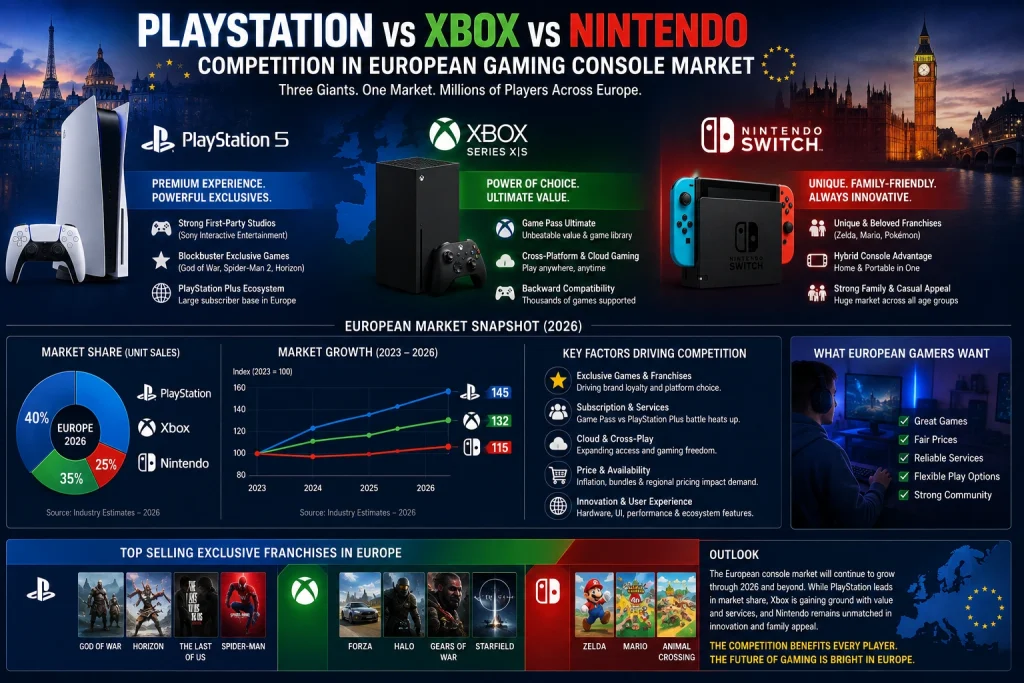
The European console market is dominated by a small number of platform ecosystems, but their strategies are becoming increasingly different.
PlayStation
Sony’s PlayStation business remains a major force in the console segment. Sony reported more than 93 million PlayStation 5 units sold worldwide as of March 31, 2026, demonstrating the scale of the current generation.
For Europe, PlayStation’s strengths include a large installed base, major first-party franchises, strong third-party relationships and a mature digital ecosystem.
The strategic challenge is keeping existing owners engaged throughout a long console generation while convincing consumers that upgraded hardware or new software justifies additional spending.
Xbox
Xbox’s competitive position is increasingly ecosystem-oriented rather than being defined solely by the number of physical consoles sold.
Microsoft’s approach has emphasized services, subscriptions, backward compatibility, PC integration and cloud gaming. That creates an interesting dynamic in Europe: the gaming ecosystem can reach consumers who do not necessarily own the latest Xbox hardware.
For the overall console market, this is a significant shift. Competition is no longer simply “which box sits under the television?” It is increasingly about where players buy games, maintain subscriptions, access friends and preserve their digital libraries.
Nintendo
Nintendo occupies a distinct position because of its family-friendly franchises and hybrid hardware strategy.
Switch demonstrated that a console could compete successfully by emphasizing flexibility and exclusive software rather than matching the technical specifications of PlayStation or Xbox.
Switch 2 extends that strategy into a newer generation. Its strong worldwide sales through March 2026 suggest that Nintendo has a substantial opportunity to maintain momentum in Europe as the platform’s software library expands.
Europe Gaming Console Market Trends Through 2035
The next decade will probably not look like the console market of the 2010s. Several trends stand out.
1. Hardware Growth Will Become More Selective
Mature European markets already have large installed bases. That means future sales depend heavily on replacement cycles and compelling reasons to upgrade.
A console that is only marginally better may struggle to persuade an existing owner. Hardware companies therefore need clearer differentiation through performance, convenience, exclusive content, portability or ecosystem benefits.
2. Hybrid and Portable Gaming Will Gain Importance
The success of the Switch formula demonstrated the appeal of playing across television and handheld environments.
That concept could influence the wider industry through 2035. Consumers increasingly expect their entertainment to follow them rather than remain tied to one room.
3. Cloud Gaming Will Complement, Not Immediately Replace, Consoles
Cloud gaming can reduce the need for expensive local hardware, particularly where high-speed internet is reliable. Research into the broader console market already identifies cloud and subscription gaming as growth drivers.
Still, local hardware has major advantages: predictable performance, low latency, offline capability and access to high-end graphics without depending entirely on network conditions.
The more realistic scenario is coexistence. High-end consoles, handheld devices and cloud services will increasingly work together.
4. Recurring Revenue Will Matter More
Subscriptions can make customer relationships more predictable. Digital storefronts also allow manufacturers and publishers to monetize an installed base repeatedly.
This makes the size of the active player base increasingly important. A console is no longer just a one-time hardware transaction; it can be the foundation for years of software and service revenue.
5. Sustainability and Regulation Will Influence Hardware
European consumers and regulators are paying greater attention to repairability, energy consumption, packaging, digital consumer rights and electronic waste.
Over the 2026–2035 period, manufacturers may face greater pressure to design hardware that lasts longer, consumes less energy and can be serviced more easily. These factors could influence purchasing decisions as well as product development.
What Is the Outlook for the Europe Gaming Console Market Through 2035?
The strongest outlook is one of moderate hardware expansion combined with deeper ecosystem monetization.
IndexBox expects European console consumption to rise from around 18 million units in 2023 to approximately 20 million by 2035 under its methodology, while other research firms forecast substantially faster revenue growth.
These figures are not necessarily contradictory. Revenue can grow faster than unit volumes when consumers move toward more expensive hardware, premium editions, accessories and higher-value digital services.
By 2035, the definition of a “console market” may also be broader than it is today. Traditional living-room consoles could sit alongside handheld PCs, hybrid systems, streaming devices and cloud-connected hardware.
The biggest winners are likely to be platforms that make this transition feel seamless. Players do not particularly care whether a game is being delivered through a console, cloud server or handheld device. They care that their games work, their friends are online and their purchases remain accessible.
That is the real competitive battleground.
Frequently Asked Questions
What is the Europe gaming console market size in 2026?
Current research estimates vary by methodology. One forecast puts the European gaming-console market at about $4.8 billion in 2025, while another estimates $5.07 billion. Differences reflect market definitions, geography and valuation methods.
What is the expected growth rate of the Europe gaming console market?
Forecasts differ significantly. Global Market Insights estimates a 2.1% CAGR for 2026–2035, while Grand View Research forecasts 7.8% annual growth from 2026–2033. The difference largely reflects methodology and market scope.
Which countries are the biggest gaming console markets in Europe?
Germany, the UK and France are among Europe’s leading gaming markets. Within the EU, Germany, Spain and France were identified as the largest markets by console consumption in IndexBox’s 2024 analysis.
Will cloud gaming replace consoles by 2035?
Cloud gaming is likely to become more important, but complete replacement is far from certain. Local consoles offer performance, convenience and low-latency advantages, so the more likely outcome is a hybrid ecosystem combining consoles, handhelds and cloud services.
Conclusion
The Europe gaming console market is not a declining hardware category waiting to be replaced. It is evolving.
Growth through 2035 will likely come less from simply selling millions of additional boxes and more from extending the value of every active player through premium hardware, digital games, subscriptions, accessories and connected services. Western Europe will remain the revenue anchor, while Central and Eastern Europe offer additional penetration opportunities.
For companies operating in this market, the winning question is no longer just “How many consoles can we sell?” It is “How valuable can each gaming ecosystem become over its lifetime?” That shift will shape Europe’s console industry throughout the 2026–2035 forecast period.