


A cricket ball disappearing over a boundary is exciting. Watching it fly 120 metres or more is something else entirely. Over the years, several batters have produced enormous hits, but one name almost always appears when fans ask about the longest six in cricket history: Shahid Afridi. The famous 153–158 metre claim is spectacular, yet the record becomes surprisingly complicated when you look at how old sixes were measured. Here is what the evidence actually tells us.
Quick Summary
- Shahid Afridi’s famous Johannesburg six is commonly reported at 153–158 metres, but that figure is disputed.
- Brett Lee’s 2005 Gabba hit is estimated at 130–135 metres by Charles Davis’ detailed analysis.
- Martin Guptill hit a 127-metre six against South Africa in 2012, one of the strongest modern measured claims.
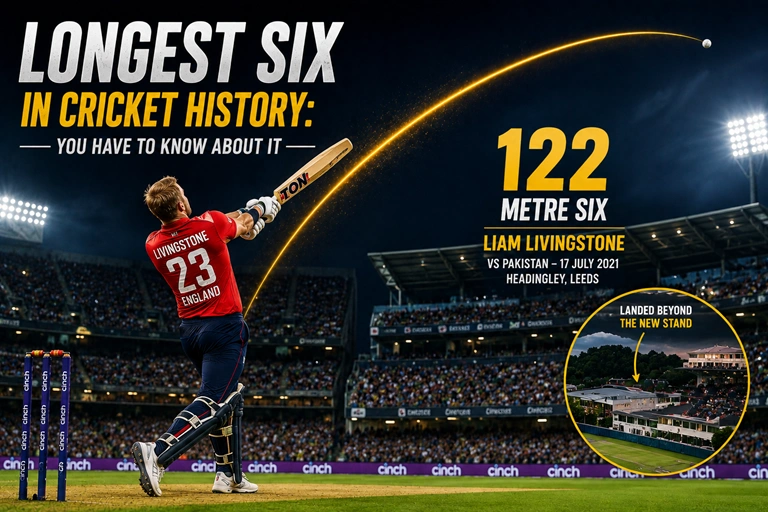
- Liam Livingstone produced a spectacular 122-metre six against Pakistan in 2021.
- There is no single universally audited official world record for the longest six because measurement methods have changed dramatically over cricket’s history.
What Is the Longest Six in Cricket History?
If you ask fans for the answer, Shahid Afridi is likely to be the first name mentioned.
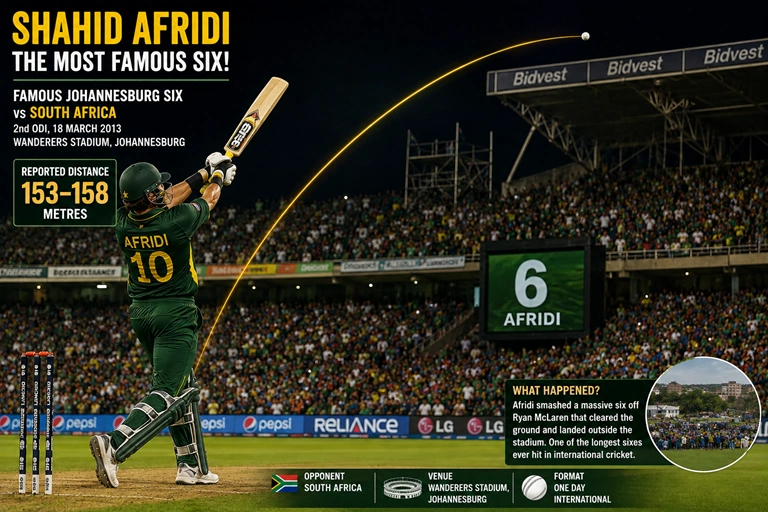
During Pakistan’s ODI against South Africa at Johannesburg in March 2013, Afridi launched a huge six that cleared the stadium area. Contemporary and subsequent reports have commonly described the hit as 153 metres, while many online lists have rounded or reported it as 158 metres.
That is the figure most often presented as the longest six in cricket history.
There is, however, an important qualification. A detailed analysis by cricket statistician Charles Davis examined the geometry and available video evidence of historic big hits. His list puts Afridi’s Johannesburg strike at approximately 120 metres of unimpeded distance, rather than the frequently repeated 153–158 metre figure.
So which number should a responsible cricket article use?
The best answer is to give both pieces of information rather than pretending the debate does not exist: Afridi owns the most famous claimed record, but the 153–158 metre figure is not securely verified by modern standards.
That distinction matters when comparing it with sixes measured using trajectory-tracking technology.
Why Is Shahid Afridi’s 158-Metre Six Controversial?
The story of Afridi’s enormous hit has everything cricket fans love.
It happened at the Wanderers in Johannesburg, a venue known for producing big sixes. Afridi was facing Ryan McLaren during Pakistan’s innings when he sent the ball soaring out of the playing area. The shot became famous almost immediately and has since appeared in countless lists of the biggest sixes ever.
Some sources report 153 metres, while others call it 158 metres.
The problem is measurement.
Modern cricket broadcasts can use ball-tracking systems to estimate the trajectory and distance of a shot. Older matches did not have the same technology. A ball that clears a roof, lands away from the stadium or rolls after landing can make the apparent distance much greater than the actual distance travelled through the air.
Charles Davis’ research separates the distance a ball actually carries from the distance it may travel after hitting a structure or the ground. His analysis lists Afridi’s Johannesburg six at about 120 metres on an unimpeded basis.
That does not make Afridi’s shot ordinary. Far from it. A six around 120 metres is still an extraordinary strike.
It simply means the 158-metre number should be presented as a widely reported claim rather than an indisputable, officially verified measurement.
Why do online lists still say 158 metres?
Because the number has become part of cricket folklore.
A search for “longest six in cricket history” still produces many pages naming Afridi’s 158-metre strike as the definitive record. Some recent cricket publications continue to describe it as the biggest international six, while others distinguish between popular claims and technically verifiable distances.
For readers, that means context is more useful than simply repeating the largest number.
Which Other Cricketers Have Hit Huge Sixes?
Afridi is not alone. Several batters have produced measured or strongly documented sixes in the 120-metre-plus range.
1. Brett Lee — approximately 130–135 metres
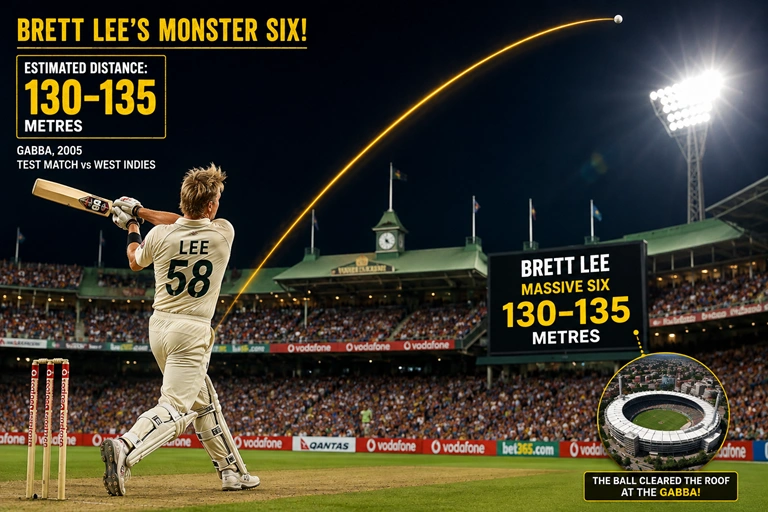
Brett Lee is an unusual name on a list of cricket’s biggest sixes because he was primarily known as one of Australia’s fastest bowlers.
In a Test match at the Gabba in 2005, Lee smashed a massive six. Charles Davis’ analysis places the unimpeded distance at approximately 130–135 metres. The hit is particularly interesting because Lee used a non-standard carbon-fibre-reinforced bat that was subsequently banned.
Some reports have described the shot as 143 metres, but the more carefully analyzed figure is lower. That distinction is another reminder that different cricket records cannot always be compared on an equal basis.
Even at 130–135 metres, though, Lee’s strike is remarkable.
2. Martin Guptill — 127 metres
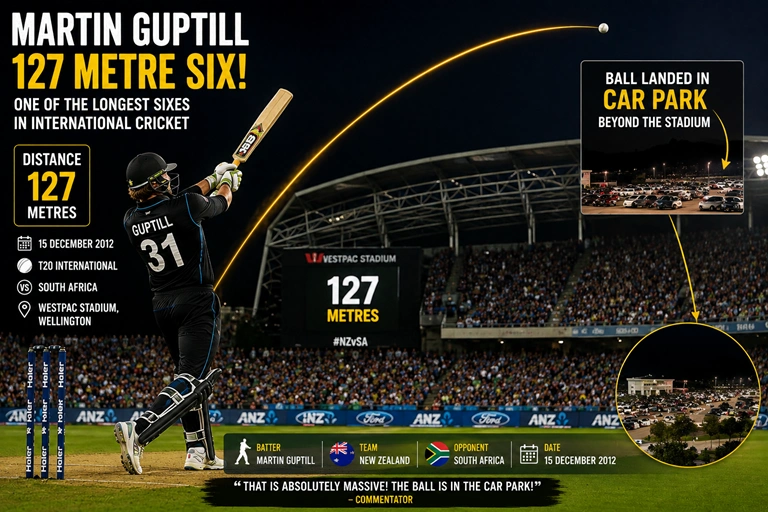
Martin Guptill produced one of the best modern examples of long-distance hitting against South Africa in a T20 international in Wellington in 2012.
The six was measured at 127 metres, and the ball landed in the car park after clearing the stadium structure. Charles Davis’ research identifies this shot as one of the strongest documented modern measurements, with trajectory-tracking technology supporting the estimate.
Wisden also records Guptill’s 127-metre strike and notes that it came against South Africa at Westpac Stadium.
For anyone looking for the longest six in international cricket based on modern tracking, Guptill’s name deserves particular attention.
3. Albie Morkel — 124–125 metres
South African all-rounder Albie Morkel was another renowned power hitter.
His huge IPL six in Chennai has been estimated at around 124–125 metres. The shot is included among Charles Davis’ more credible long-distance hits.
Morkel’s inclusion also highlights something often overlooked in these lists: the IPL has produced some extraordinary sixes because aggressive batting, smaller boundaries at certain venues and modern broadcast technology have made big hitting a major part of the spectacle.
4. Liam Livingstone — 122 metres
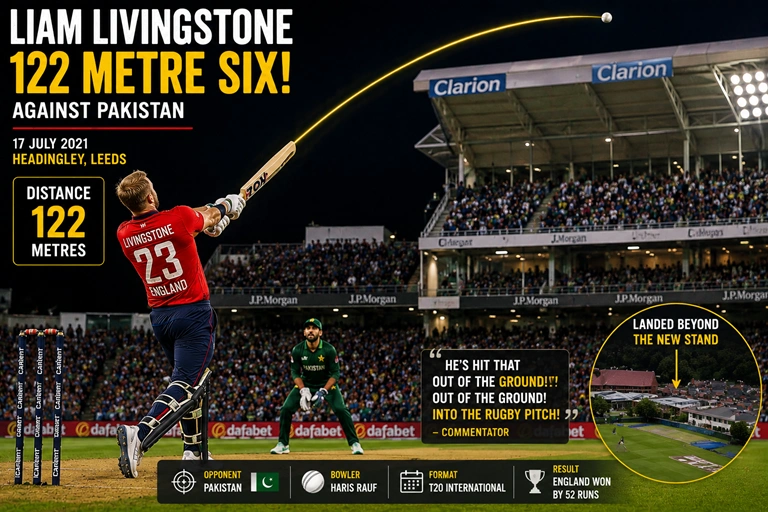
Liam Livingstone’s 2021 six against Pakistan became an instant viral cricket moment.
Facing Haris Rauf at Headingley, Livingstone struck the ball over the new South Stand and onto the rugby pitch beyond the cricket ground. The hit was widely reported at 122 metres. ESPN later described it as a 122-metre six that cleared the new stand.
The shot was so enormous that commentators initially wondered whether it might be the biggest six ever seen.
It wasn’t, at least according to the available measurements, but it remains one of the most spectacular long sixes of the modern era.
5. Mark Waugh — 120 metres
Long before today’s T20 power-hitting culture, Australia’s Mark Waugh showed that Test cricket could produce enormous hits too.
Davis’ list records Waugh hitting a 120-metre six at the WACA in 1997 against New Zealand.
The WACA was historically associated with pace and bounce, and its large dimensions made a 120-metre hit particularly impressive.
What Are the Biggest Measured Sixes?
A useful way to understand the record is to separate famous claims from the better-supported measurements.
| Player | Reported/estimated distance | Format/context |
|---|---|---|
| Brett Lee | 130–135 m | Test, Gabba, 2005 |
| Aiden Blizzard | 130 m | Domestic T20, WACA, 2008 |
| Martin Guptill | 127 m | T20I, Wellington, 2012 |
| Albie Morkel | 124–125 m | IPL, Chennai, 2008 |
| Simon O’Donnell | 122 m | First-class, MCG, 1993 |
| Adam Gilchrist | 122 m | IPL, 2011 |
| Mark Waugh | 120 m | Test, WACA, 1997 |
| Shahid Afridi | ~120 m unimpeded | ODI, Johannesburg, 2013 |
| Liam Livingstone | 122 m | T20I, Headingley, 2021 |
These figures come from the more carefully documented list compiled by Charles Davis, which distinguishes unimpeded distance from less reliable historical claims.
There is an interesting pattern here: once questionable historical estimates are removed, the 120–130 metre range is where many of the most credible giant sixes sit.
How Is the Distance of a Cricket Six Measured?
This sounds simple until you actually try to measure it.
A six does not necessarily travel in a straight line from the bat to the point where it lands. The ball follows an arc. It may also hit a roof, stand or advertising structure before falling.
Modern tracking systems can estimate the ball’s trajectory and calculate how far it would have travelled without an obstruction. That is why modern measurements are more useful for comparisons than old-fashioned estimates based on where the ball was eventually found.
Charles Davis specifically used video evidence and geographic analysis for several historical shots. His research describes distances as “unimpeded”, essentially asking how far the ball travelled before returning to ground level.
This creates an important difference between two statements:
- “The ball landed 130 metres from the batter.”
- “The ball carried 130 metres through the air.”
They are not necessarily the same thing.
Wind, elevation, stadium architecture, ball trajectory, camera angles and the point from which the measurement begins can all influence the reported number.
That is why a sensible cricket longest six record should always mention the measurement method when possible.
Does the Longest Six Record Really Belong to Afridi?
It depends on what you mean by “record.”
If you mean the most widely reported and famous distance, Shahid Afridi’s 153–158 metre Johannesburg six is the obvious answer.
If you mean the longest carefully analyzed historical strike using an unimpeded-distance methodology, Brett Lee’s 130–135 metre Gabba hit has a stronger case in the Davis dataset.
If you restrict the comparison to modern international hits with credible trajectory tracking, Martin Guptill’s 127-metre six is one of the clearest benchmarks.
This is why articles claiming that one player has an absolutely uncontested “official” world record can be misleading. Cricket has never maintained a single standardized database of every six’s distance across all eras and competitions.
There are also legendary older stories. Albert Trott famously cleared the Lord’s pavilion in 1899, while other historical accounts describe extraordinarily long hits. But without standardized tracking, putting those shots into a modern metre-by-metre ranking is difficult.
Why Do Some Cricket Sixes Go So Far?
Distance is not just about muscle.
The biggest sixes usually combine several factors:
Bat speed: A fast-moving bat transfers more energy to the ball.
Timing: A perfectly timed shot can travel farther than a harder swing that catches the ball poorly.
Launch angle: The trajectory needs to be high enough to clear obstacles without wasting too much energy vertically.
Bowling speed: Fast bowling can add energy to a well-timed shot because the batter is redirecting an already fast-moving ball.
Bat technology: Modern bats have helped power hitters generate tremendous distances, although equipment regulations limit what is legal.
Weather and venue: Wind, altitude and ground dimensions can influence how a ball behaves and how its distance is perceived.
Livingstone’s 122-metre strike illustrates this perfectly. He did not simply swing as hard as possible. He got underneath a delivery from Haris Rauf and generated the combination of elevation, timing and power needed to clear the stand.
That’s what makes elite power hitting so difficult. Anyone can swing hard. Very few players consistently find the middle of the bat while producing the right trajectory.
FAQ: Longest Six in Cricket History
Who hit the longest six in cricket history?
Shahid Afridi is most commonly credited with the longest six, with his famous Johannesburg strike against South Africa reported at 153–158 metres. However, that measurement is disputed, and detailed analysis puts the unimpeded distance closer to 120 metres.
Is Shahid Afridi’s 158-metre six officially verified?
Not by modern measurement standards. The 158-metre figure is widely reported, but detailed analysis of the shot disputes that distance. It is safer to describe it as the most famous claimed record rather than an uncontested official record.
Who hit the longest verified six?
Brett Lee’s 2005 Gabba strike is estimated at 130–135 metres in Charles Davis’ detailed analysis. Martin Guptill’s 127-metre six in 2012 is another particularly strong modern, trajectory-supported measurement.
How far was Liam Livingstone’s biggest international six?
Livingstone hit a 122-metre six against Pakistan at Headingley in July 2021. The shot cleared the new South Stand and landed on the rugby pitch beyond the cricket ground.
Conclusion
The search for the longest six in cricket history has a fascinating twist: the biggest number is not necessarily the most reliable record.
Shahid Afridi’s 153–158 metre strike remains one of cricket’s most famous monster hits, but its exact distance is disputed. Brett Lee’s 130–135 metre Gabba shot, Martin Guptill’s 127-metre blast and Liam Livingstone’s 122-metre Headingley strike provide better context for what elite long-distance hitting actually looks like.
So, rather than asking only, “Who hit the longest six?”, ask a better question: Which long six has the strongest evidence behind its distance? Once measurement methods are taken into account, the answer becomes much more interesting—and considerably more accurate.