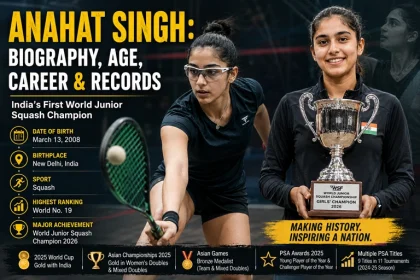


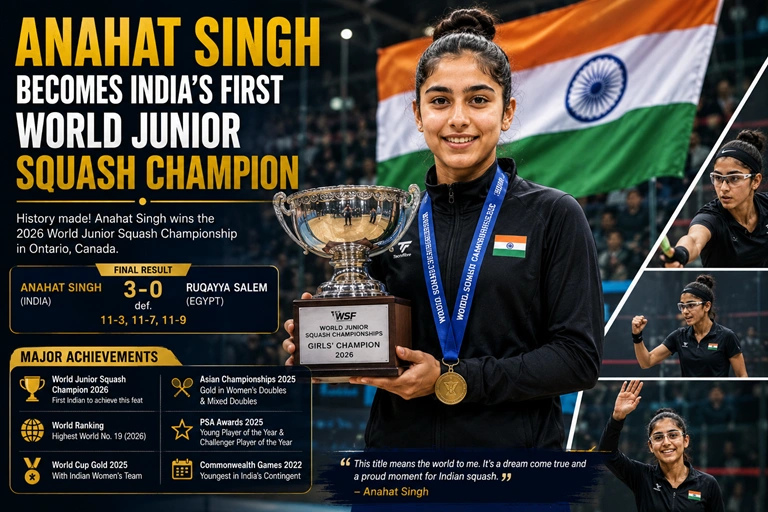
For years, the World Junior Squash Championship was one of the titles that Indian squash could admire but never claim. Anahat Singh changed that on July 25, 2026. The 18-year-old Delhi player defeated Egypt’s Ruqayya Salem in straight games in Niagara-on-the-Lake, Ontario, to become India’s first World Junior Squash Champion. The 11-3, 11-7, 11-9 victory was more than another trophy for a rising star—it was a landmark moment for Indian squash.
Quick Summary
- Champion: Anahat Singh
- Tournament: 2026 World Squash Junior Individual Championships
- Location: Niagara-on-the-Lake, Ontario, Canada
- Final opponent: Ruqayya Salem of Egypt
- Final score: Anahat Singh won 11-3, 11-7, 11-9
- Result: 3-0 victory for Anahat
- Historic record: First Indian player to win the World Junior Squash Championship
- Age: 18
- Seeding: No. 1
- Senior PSA ranking at the tournament: World No. 20
- Previous World Junior result: Bronze medal in 2025
How Did Anahat Singh Make History?
Anahat Singh entered the 2026 World Junior Championships carrying both expectation and unfinished business.
She had already reached the semifinals of the previous edition and won a bronze medal in 2025. Before that, she had experienced the frustration of falling short in earlier editions. In fact, 2026 represented her final opportunity to win the junior world title before moving fully beyond the junior level.
This time, she did not let the opportunity slip.
As the tournament’s top seed, Anahat navigated the knockout stages and eventually reached a final against Egypt’s second seed Ruqayya Salem. The matchup carried additional significance because Egypt had dominated the girls’ event for years. Anahat’s victory broke that long-running Egyptian hold and gave India its first women’s individual World Junior title.
The final itself was remarkably controlled.
Anahat won the opening game 11-3, putting immediate pressure on Salem. She followed it with an 11-7 second game before closing the championship with an 11-9 third-game victory. There was no deciding game, no late collapse and no need for a dramatic comeback. The Indian teenager finished the job in three games.
Who Did Anahat Singh Beat in the World Junior Final?
Anahat defeated Ruqayya Salem of Egypt, the tournament’s No. 2 seed, by a score of 11-3, 11-7, 11-9.
Salem represented one of the strongest squash nations in the world, making Anahat’s victory even more significant. Egypt has traditionally been a powerhouse in junior and senior squash, and its players have dominated the women’s World Junior Championship for much of the modern era.
Anahat’s straight-games victory therefore carried significance beyond the scoreline. She was not simply winning an individual final; she was overcoming one of the sport’s strongest junior systems on the biggest junior stage.
The final result also surpassed India’s previous best performance in the women’s World Junior Championship. Joshna Chinappa had reached the final in 2005, but India had never produced a champion until Anahat’s breakthrough in 2026.
Final Score
| Player | Game 1 | Game 2 | Game 3 | Result |
|---|---|---|---|---|
| Anahat Singh (India) | 11 | 11 | 11 | Won 3-0 |
| Ruqayya Salem (Egypt) | 3 | 7 | 9 | Runner-up |
The progression of the scores tells an interesting story. Salem became increasingly competitive as the match progressed, but Anahat remained composed enough to close the third game 11-9 rather than allowing the contest to go deeper.
Why Is Anahat Singh’s Victory So Important for Indian Squash?
Winning a world title is significant for any athlete. For Anahat, the achievement has an extra layer because of what it represents for Indian squash.
India has produced accomplished squash players over the years, including Joshna Chinappa, Dipika Pallikal Karthik and Saurav Ghosal. Indian players have won medals at Commonwealth Games, Asian Games and other major international events. Yet the women’s individual World Junior Championship title had remained out of reach.
Anahat has now removed that gap from India’s record.
Her achievement also arrives at an interesting time for squash. The sport is preparing for its Olympic debut at the Los Angeles 2028 Olympic Games, giving young players such as Anahat a much larger international stage to aim for.
That does not mean a junior world title guarantees future Olympic success. Squash is an extremely competitive professional sport, and the transition from junior to senior competition can be difficult. But Anahat has already shown that she is capable of competing successfully beyond the junior circuit.
That may be the most encouraging part of the story.
Anahat Singh’s Rise Was Built Before the 2026 World Junior Title
The world title did not come out of nowhere.
Anahat had already established herself as India’s No. 1 women’s squash player and had reached World No. 20 on the senior PSA Tour by the time she arrived in Canada. That means she was simultaneously one of the world’s strongest junior players and an established competitor on the senior circuit.
Her 2026 season had already delivered an important professional breakthrough.
Earlier in the year, Anahat won the Squash On Fire Open in Washington, defeating England’s Georgina Kennedy in the final. The victory helped her break into the world’s top 20 and reinforced the impression that she was ready to compete against established senior players. Vogue India reported that the title made her the youngest Asian player to reach the world’s top 20.
That experience mattered in Canada.
Anahat was not entering the World Junior Championship as an unknown teenager hoping for a surprise run. She arrived as the top seed and as a player accustomed to the pressure of senior professional competition.
From Early Junior Success to World Champion
Her junior career had already included important international results. She had won major age-group competitions, including titles at the British Junior Open and US Junior Open, before progressing into senior squash.
She also represented India at the 2022 Commonwealth Games in Birmingham at age 14, becoming the youngest member of India’s contingent. That early exposure to elite international competition helped accelerate her development.
The pattern is clear: Anahat has been moving up the competitive ladder for years.
Junior titles led to senior tournaments. Senior tournaments led to ranking gains. Ranking gains led to victories over established professionals. And eventually, those experiences came together in her historic World Junior Championship run.
What Happened During Anahat Singh’s Road to the Final?
Anahat’s route to the championship match was another sign of her consistency.
In the quarterfinal, she defeated Egypt’s Habiba Rizk 3-1. She then faced another Egyptian opponent, Barb Sameh, in the semifinal and won 3-1 to reach the final. By doing so, she became the first Indian player to reach the women’s World Junior final since Joshna Chinappa’s appearance in 2005.
That semifinal was particularly meaningful because Anahat had previously experienced disappointment at the tournament. She had reached the semifinals in the previous edition and had been unable to advance further.
This time, she did.
And once she reached the final, she delivered her most convincing performance of the tournament.
According to NDTV’s report, Anahat dropped only two games across her six matches during the championship.
That statistic gives useful context to the title. Her victory was not built on surviving one difficult match after another. She was consistently in control throughout the tournament.
What Makes Anahat Singh’s Achievement Different?
There is a temptation to look at Anahat’s age and describe her simply as a teenage sensation. The numbers suggest something more substantial.
At 18, she already had experience at the Commonwealth Games, major junior championships, senior PSA events and world-level competition. Her senior ranking had reached the top 20, while her junior career ended with the one title that had previously escaped her.
Her 2026 World Junior victory also came after repeated attempts.
That matters psychologically. An athlete who wins a major championship on the first attempt faces one kind of pressure. An athlete who has experienced quarterfinal and semifinal exits, returned the following year and finally wins the title has learned how to deal with disappointment.
Anahat herself acknowledged the importance of the moment after the final, saying the title “means the world” to her. She also described the tournament as her final chance to win the junior crown.
That context makes the championship more than a statistic on a résumé.
It is the culmination of several years of trying.
What Does the Title Mean for Anahat Singh’s Future?
The biggest question now is what comes next.
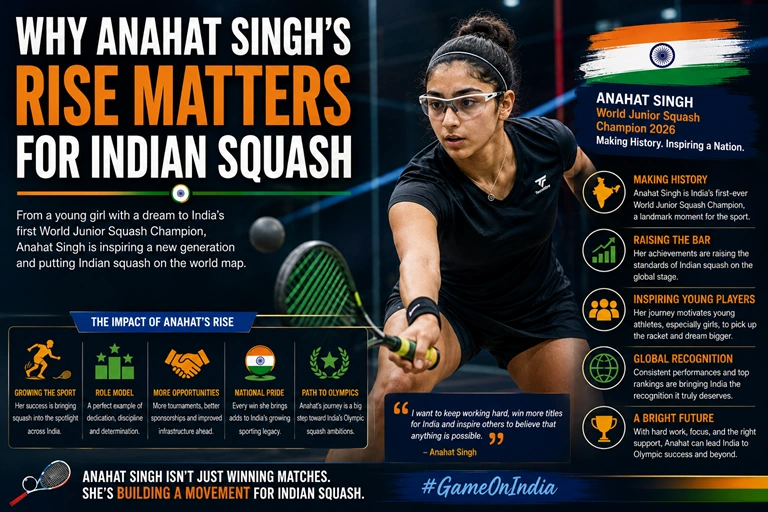
Anahat has effectively completed the junior portion of her career. The next challenge is to establish herself among the world’s best senior players.
Reaching World No. 20 is an excellent foundation, but the gap between the top 20 and the very top of the PSA rankings is substantial. The world’s leading players bring years of experience, physical strength, tactical sophistication and the ability to maintain performance throughout a long season.
Anahat has already demonstrated that she can beat highly ranked opponents. Her Squash On Fire Open victory over Georgina Kennedy is one example. Her continued progress will depend on whether she can produce those performances consistently against the world’s strongest players.
The timing could hardly be more interesting.
Squash is scheduled to make its Olympic debut at Los Angeles 2028. Anahat will be 20 years old during the Games, putting her in an age range where her physical and tactical development could be entering an important phase.
It would be premature to predict an Olympic medal. A more reasonable expectation is that the next two years will be about turning her junior and early senior success into sustained world-class performance.
If she manages that transition, her 2026 world junior title could eventually be remembered as the beginning of an even bigger story.
Anahat Singh’s Historic Achievement at a Glance
- First Indian World Junior Squash Champion: Anahat is the first Indian player to win the women’s World Junior title.
- Final opponent: Egypt’s Ruqayya Salem.
- Final score: 11-3, 11-7, 11-9 in Anahat’s favour.
- Tournament seeding: No. 1.
- Senior ranking: World No. 20 around the time of the championship.
- Previous best Indian women’s result: Joshna Chinappa’s runner-up finish in 2005.
- Previous Anahat result: Bronze medal at the 2025 World Junior Championships.
- Professional milestone in 2026: Squash On Fire Open champion and top-20 player.
- Next major horizon: The Los Angeles 2028 Olympics, when squash is set to make its Olympic debut.
FAQ: Anahat Singh World Junior Champion
Who is Anahat Singh?
Anahat Singh is an Indian professional squash player from New Delhi. At 18, she became the first Indian to win the World Junior Squash Championship after defeating Egypt’s Ruqayya Salem in the 2026 final.
When did Anahat Singh become World Junior Squash Champion?
Anahat Singh won the World Junior Squash Championship on July 25, 2026, in Niagara-on-the-Lake, Ontario, Canada. She defeated Ruqayya Salem 11-3, 11-7, 11-9.
What is Anahat Singh’s world ranking?
Anahat Singh was ranked World No. 20 on the PSA Tour around the 2026 World Junior Championship. She had previously broken into the senior world’s top 20 after winning the Squash On Fire Open.
What makes Anahat Singh’s World Junior title historic?
Anahat became the first Indian player to win the World Junior Squash Championship. Her victory surpassed Joshna Chinappa’s previous Indian best of reaching the final in 2005 and ended a long period of Egyptian dominance in the women’s event.
Conclusion
Anahat Singh’s 2026 World Junior Championship victory is a landmark for Indian squash because it combines a historic first with evidence of genuine long-term development.
She did not arrive in Canada as an outsider. She arrived as the top seed, India’s No. 1 player and a top-20 competitor on the senior PSA Tour. Then she backed up that status with a dominant tournament and a straight-games victory over Ruqayya Salem.
The junior title closes one chapter of Anahat Singh’s career. The more difficult chapter begins now: becoming a consistent force in senior squash.
With the Los Angeles 2028 Olympics approaching and her senior ranking already inside the world’s top 20, Indian squash has plenty of reason to watch what happens next.
Anahat has already made history. Now she has the opportunity to build on it.